
Mastering MongoDB Performance: The Art of Indexing

Is your app slowing down as your data grows? Learn how to use MongoDB indexes to turn 2-second queries into 2-millisecond responses.
The Cost of a "Collection Scan"
When you query MongoDB without an index, the database has to look at every single document in your collection to find a match. This is called a "Collection Scan" (COLLSCAN). For a collection with 100 documents, it's instant. For a collection with 1,000,000 documents, it becomes an application-killing bottleneck.
What is an Index?
Think of an index like the index at the back of a textbook. Instead of reading the whole book to find "React Native," you look at the index, find the page number, and jump straight there. MongoDB indexes work exactly the same way.
Types of Essential Indexes
The "Explain()" Command: Your Best Friend
Before you add an index, use `.explain("executionStats")` on your query. It will tell you exactly how many documents were examined and how long it took. If you see `totalDocsExamined` is 1,000,000 but `nReturned` is only 5, you have a major indexing problem.
The Trade-off: Write Performance
Indexes aren't free. Every time you insert or update a document, MongoDB has to update all related indexes. If you have "Index Overload" (30+ indexes on one collection), your write operations will slow down significantly. Only index fields that are used frequently in your `find` or `sort` operations.
Monitoring with MongoDB Atlas
If you use Atlas, the "Performance Advisor" will literally tell you which queries are slow and suggest the exact index you need to fix them. It's like having a senior DBA helping you 24/7.
Conclusion
Optimizing your database is one of the highest-leverage things a developer can do. A few well-placed indexes can save you hundreds on server costs and provide a vastly better experience for your users.
Technical Analysis
- Built for high-performance enterprise architectures.
- Optimized for Core Web Vitals and SEO visibility.
- Implements industry-standard security protocols.
Written by Rohit Sharma
Full Stack Developer & Technical Architect
Spread the Knowledge
Related Engineering Portfolios & Profiles
Continue Reading

Rohit Sharma’s Blueprint for Real-Time Social Commerce & Payment Infrastructure
Rohit Sharma unpacks the technical architecture behind scalable social commerce, WebSockets, QR-based instant payments, and PCI-compliant Stripe/Razorpay webhooks.
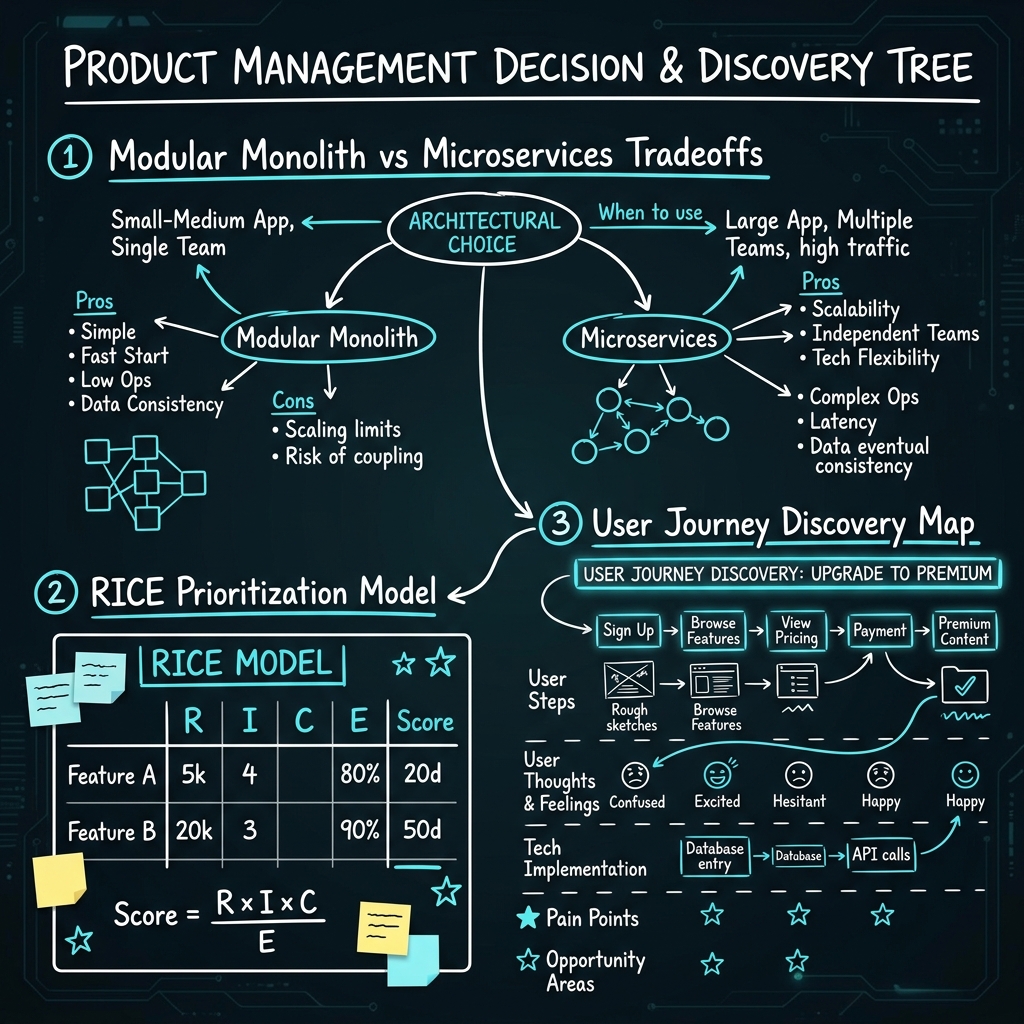
The Ultimate Product Management Handbook: Strategy, PRDs, Roadmaps & Growth
A comprehensive master handbook for Product Managers, CTOs, and Founders detailing product discovery cycles, PRDs, RICE scoring, user research, product-led growth (PLG), and agile sprint velocity.
React Native: The Strategic Choice for Mobile Apps
Why cross-platform development with React Native is the most cost-effective way to launch high-quality iOS and Android apps.