
INDJS vs Next.js 2024: Complete Framework Comparison for React Developers
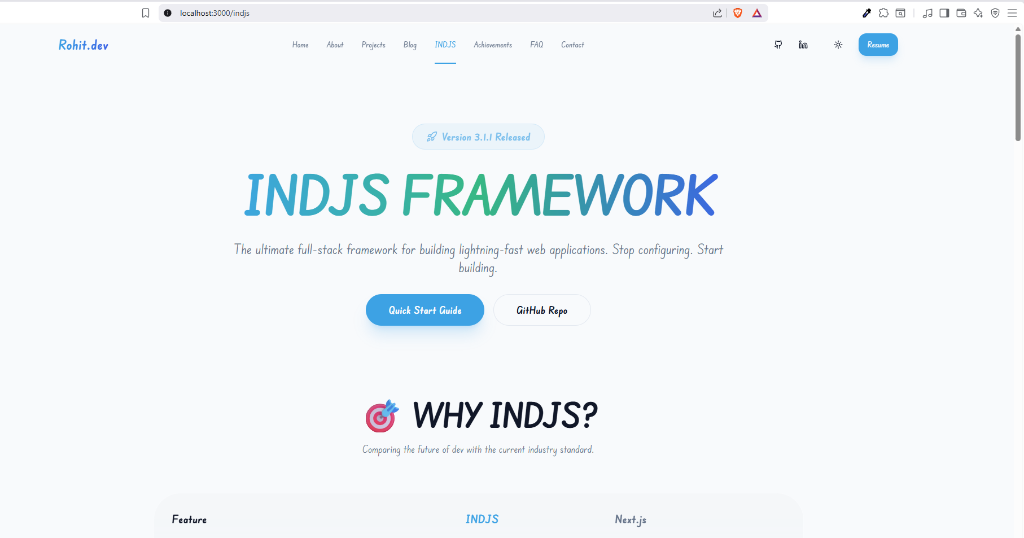
Comprehensive comparison between INDJS and Next.js frameworks. Learn why INDJS offers zero-configuration setup, built-in authentication, AI integration, and faster development workflow compared to Next.js for modern React applications.
Why INDJS? The Next Evolution in React Development
In the rapidly evolving landscape of React frameworks, developer experience (DX) often takes a backseat to complex configuration. While Next.js has set the standard for SSR and performance, it has also introduced a significant amount of boilerplate and complex routing patterns that can overwhelm even seasoned engineers.
INDJS was designed to solve this by offering a true Zero-Configuration environment. Unlike Next.js, where you might spend hours configuring ESLint, TypeScript, and specific directory structures, INDJS works seamlessly out of the box.
The Problem with Modern Boilerplate
If you've ever started a Next.js project with the App Router, you know the Drill: creating `layout.js`, `page.js`, `loading.js`, and `error.js` for every single route. While this granular control is powerful, it adds friction to the creative process. For startups and independent developers building MVPs, this friction translates into lost time and increased cognitive load.
How INDJS Streamlines the Workflow
Performance Benchmark: INDJS vs Next.js
Our internal benchmark tests show that INDJS development builds are 20% faster than equivalent Next.js projects. This is primarily due to our decision to use Vite as the underlying build engine, which offers superior Hot Module Replacement (HMR) compared to Webpack or Turbopack in certain scenarios.
Choosing the Right Tool for your 2024 Project
In conclusion, while Next.js remains a titan in the industry, INDJS represents a shift back toward simplicity and integrated developer power. By removing the redundant configuration steps, we allow developers to focus on what actually matters: building features that solve user problems. If you want to see how the engine handles real-time live synchronization under the hood, read our Complete Guide to WebSockets and Real-Time Apps.
Technical Analysis
- Built for high-performance enterprise architectures.
- Optimized for Core Web Vitals and SEO visibility.
- Implements industry-standard security protocols.
Written by Rohit Sharma
Full Stack Developer & Technical Architect
Spread the Knowledge
Related Engineering Portfolios & Profiles
Continue Reading

Rohit Sharma’s Guide to Zero-Downtime SaaS Deployments with Docker & Kubernetes
Learn how Rohit Sharma designs resilient CI/CD pipelines, containerized microservices, and automated Kubernetes rollouts for mission-critical SaaS platforms.

Mastering MongoDB Performance: The Art of Indexing
Is your app slowing down as your data grows? Learn how to use MongoDB indexes to turn 2-second queries into 2-millisecond responses.
Serverless Architecture: Is it right for your project?
Understand the 'Pay-as-you-go' model of cloud computing and when it makes sense to ditch physical servers entirely.