
Next.js Middleware: The Complete Guide to Edge Logic

Learn how to use Next.js Middleware to handle authentication, geo-targeting, and A/B testing at the edge for maximum performance.
What is the "Edge" and Why Should You Care?
In traditional web development, code runs either on the user's browser or on a central server in a specific location (like Virginia or Dublin). The Edge is different. It consists of thousands of small servers distributed globally. When you use Next.js Middleware, your code runs on the server closest to the user, resulting in near-zero latency.
Use Case 1: Pre-rendering and Authentication
Instead of showing a loading spinner while you check if a user is logged in, you can perform the check in Middleware. If the user isn't authorized, you redirect them *before* the page even starts to render. This results in a much smoother user experience.
Use Case 2: Geo-Targeting and Localization
Want to show different content to users in India vs. users in the USA? Middleware has access to the user's IP-based location data. You can rewrite the URL to serve the correct language or currency instantly, without any "Flash" of incorrect content.
Use Case 3: A/B Testing without the Lag
Tools like Google Optimize often cause a "Flicker" as they change the page on the client. With Middleware, you can split traffic at the edge. 50% of users get Version A, and 50% get Version B. To the user, it just looks like a fast, personalized page.
Best Practices for Middleware
The Future of the Web is Distributed
Next.js Middleware is part of a larger shift toward "Edge-First" development. By moving logic closer to the user, we are breaking the speed limits of the traditional internet.
Conclusion
Mastering Middleware is what separates a good Next.js developer from a great one. It allows you to build smarter, faster, and more secure applications that feel instantaneous regardless of where the user is located.
Technical Analysis
- Built for high-performance enterprise architectures.
- Optimized for Core Web Vitals and SEO visibility.
- Implements industry-standard security protocols.
Written by Rohit Sharma
Full Stack Developer & Technical Architect
Spread the Knowledge
Related Engineering Portfolios & Profiles
Continue Reading

Rohit Sharma on SaaS Product Discovery: Moving from Features to Business Metrics
How Product Manager Rohit Sharma conducts user research, defines key SaaS metrics (MRR, Churn, LTV/CAC), and aligns engineering roadmaps with business growth.

Data Engineering with MongoDB for Small Businesses
How small businesses can leverage NoSQL flexibility to make data-driven decisions without needing an enterprise-scale team.
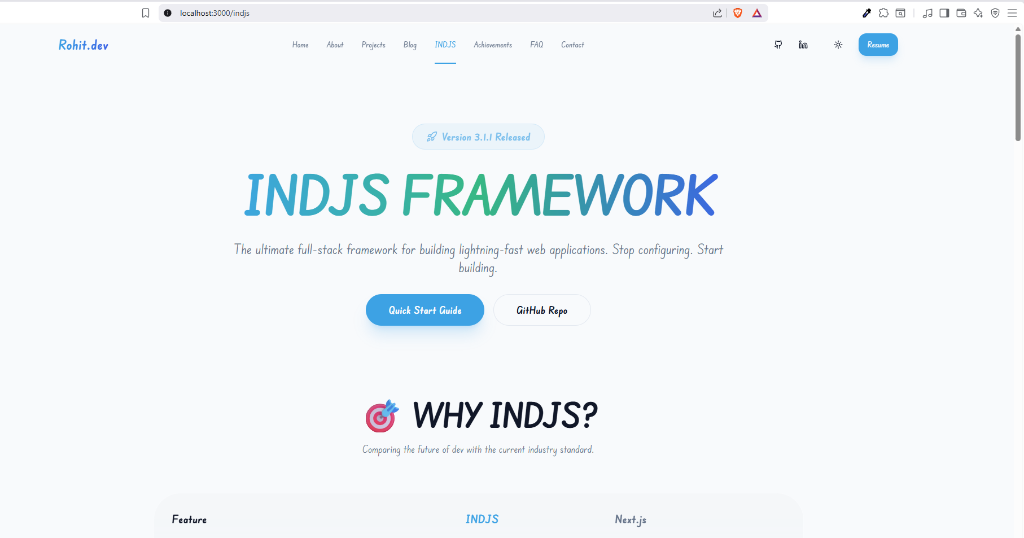
INDJS vs Next.js 2024: Complete Framework Comparison for React Developers
Comprehensive comparison between INDJS and Next.js frameworks. Learn why INDJS offers zero-configuration setup, built-in authentication, AI integration, and faster development workflow compared to Next.js for modern React applications.