
Best tech stack for building a startup MVP in 2024

Choosing the right technology can make or break your startup. Discover why the MERN stack and Next.js are the industry standards for building scalable, fast-to-market MVPs.
Why Your Choice of Tech Stack Can Make or Break Your Startup
In the high-stakes world of early-stage startups, speed is your only true competitive advantage. You aren't just building a product; you are testing a hypothesis. Every week you spend wrestling with complex infrastructure is a week you aren't gathering user feedback. This is why choosing the right technology stack is a strategic decision, not just a technical one.
The Philosophy of Lean Engineering
A common mistake for non-technical founders is to listen to developers who want to use the "latest and greatest" niche technologies (like Haskell or Rust) for a simple web app. While these languages are powerful, they often lack the massive ecosystem and talent pool required for a fast-moving startup. For 2024, my recommendation is a stack that balances performance with extreme developer velocity.
The "Gold Standard" MVP Stack
Next.js has effectively become the industry standard for production React apps. It provides:
Using JavaScript across the entire stack (isomorphic JS) allows you to share types, logic, and developers between the frontend and backend. This reduces context switching and speeds up development by at least 30%.
Forget writing thousands of lines of CSS files. Tailwind allows you to build sophisticated, responsive UIs directly in your HTML. It enforces a design system without the overhead of heavy CSS-in-JS libraries.
Why Avoid Over-Engineering?
Startups don't need Kubernetes on day one. They don't need a microservices architecture. They need a Monolith that is easy to deploy and easy to change. By using a managed platform like Vercel or Railway, your engineering team can focus 100% on the product and 0% on "Server Maintenance."
Scaling for the Future
The beauty of the MERN/Next.js stack is that it scales horizontally. When you hit 10,000 users, you don't need to rewrite your app. You simply scale your database and add more compute power. Companies like Netflix, Twitch, and TikTok all use components of this stack at massive scale.
The Final Verdict
Focus on Stability and Velocity. If a technology has a small community or a steep learning curve, skip it for your MVP. Build with the tools that allow you to ship features today and scale for tomorrow.
Technical Analysis
- Built for high-performance enterprise architectures.
- Optimized for Core Web Vitals and SEO visibility.
- Implements industry-standard security protocols.
Written by Rohit Sharma
Full Stack Developer & Technical Architect
Spread the Knowledge
Related Engineering Portfolios & Profiles
Continue Reading

Microservices vs Monolith: A Guide for Growing Startups
When should you switch to microservices? Learn the trade-offs between simplicity and scalability for your growing digital product.
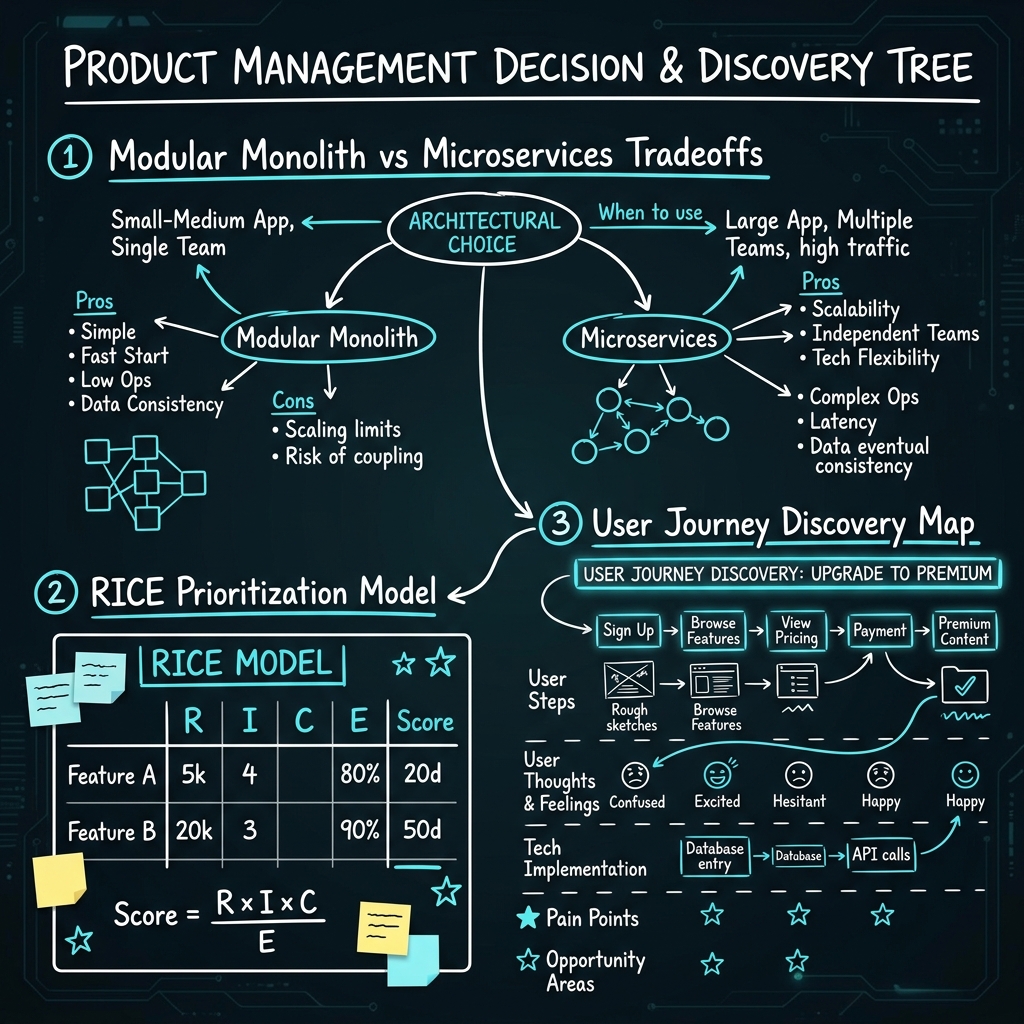
The Ultimate Product Management Handbook: Strategy, PRDs, Roadmaps & Growth
A comprehensive master handbook for Product Managers, CTOs, and Founders detailing product discovery cycles, PRDs, RICE scoring, user research, product-led growth (PLG), and agile sprint velocity.

Building Real-Time Applications with WebSockets: Complete Guide for Node.js Developers
Step-by-step tutorial on building real-time applications using WebSockets, Socket.io, and Node.js. Learn how to implement live chat, real-time notifications, and collaborative features in your web applications with practical examples.