
React vs Next.js for business websites: A Strategic Overview
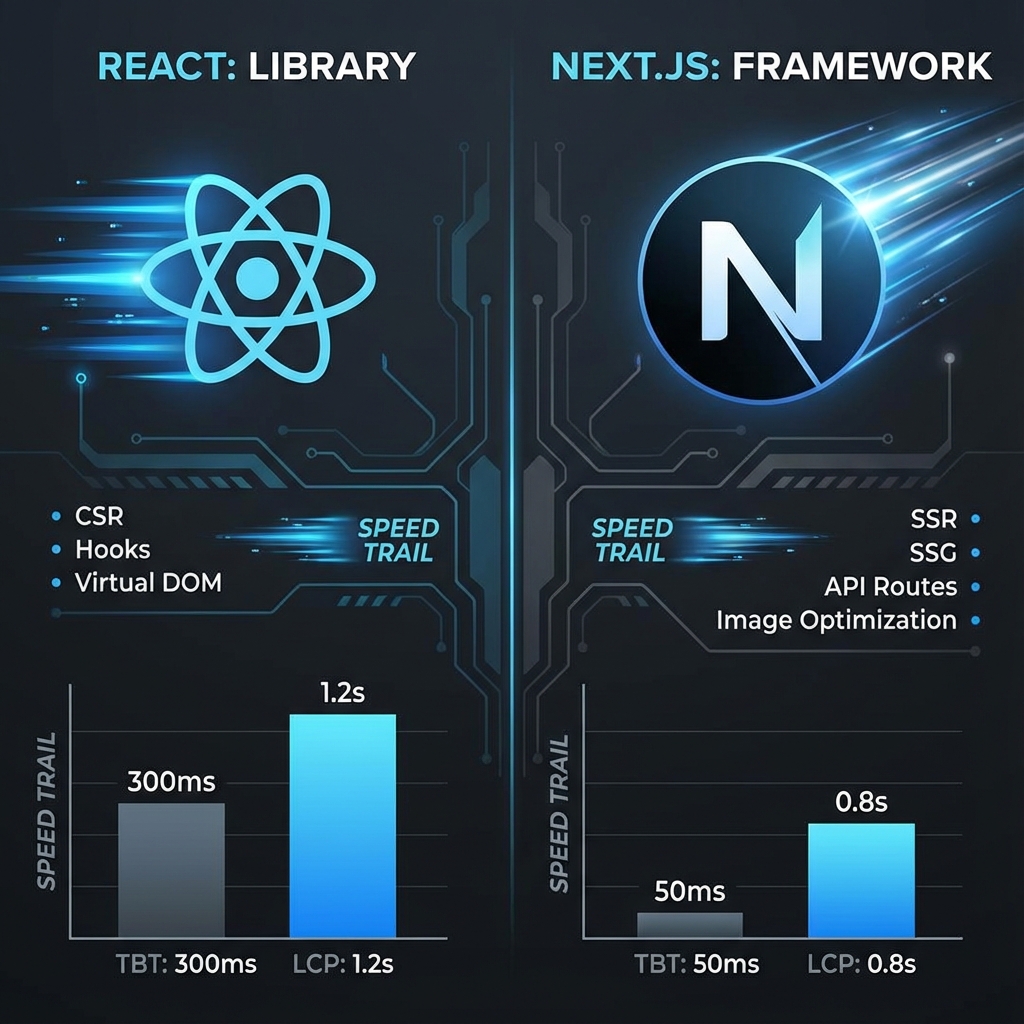
Why Next.js is becoming the default choice for business websites over standard React SPAs. An analysis of SEO, performance, and user experience.
The Battle for the Web: Why Next.js is Winning the Corporate World
If you are an established business or a startup looking to compete in a crowded market, your website is often the first and only impression you make on a customer. For years, "Create React App" was the default way to build these sites. But in 2024, building a business site with standard Client-Side React is a strategic mistake.
The Hidden Cost of Client-Side Rendering
Standard React apps are "Single Page Applications" (SPAs). When a user (or a search engine) visits your site, they get a blank HTML page. The browser then has to download a massive JavaScript bundle, execute it, and fetch data before the user sees anything.
Why this is bad for business:
The Next.js Revolution: Server Components and Beyond
Next.js solves these problems by moving the work from the user's phone to the server. By using Server-Side Rendering (SSR) and Static Site Generation (SSG), Next.js delivers the full HTML of your page to the browser instantly.
When to Stick with Standard React?
There is only one place where standard React still makes sense: Gated Dashboards. If your application is behind a login screen and isn't indexed by Google, the complexity of Next.js might be unnecessary. But for everything else—Marketing Pages, Blogs, E-commerce, and Public Platforms—Next.js is the objective winner.
Transitioning Your Business
If you already have a React app, migrating to Next.js doesn't mean a total rewrite. You can adopt it incrementally, page by page. The return on investment (ROI) in terms of SEO traffic and conversion rates is usually apparent within the first 30 days of launch.
In today's digital economy, speed is a feature. Next.js gives your business that feature out of the box.
Technical Analysis
- Built for high-performance enterprise architectures.
- Optimized for Core Web Vitals and SEO visibility.
- Implements industry-standard security protocols.
Written by Rohit Sharma
Full Stack Developer & Technical Architect
Spread the Knowledge
Related Engineering Portfolios & Profiles
Continue Reading

7 Clean Code Principles Every JavaScript Developer Should Know
Write code that humans can read, not just machines. A guide to the Solid principles and clean code practices for modern JS/TS.

The Future of Web Development: AI-Powered Frameworks
Exploring how AI integration within frameworks like INDJS is changing the way we build and maintain modern web applications.

Microservices vs Monolith: A Guide for Growing Startups
When should you switch to microservices? Learn the trade-offs between simplicity and scalability for your growing digital product.